

Pop quiz: Are Kraft and Heinz the same company?
Most people say no. They think of Kraft mac and cheese and Heinz ketchup as two completely separate brands. But Kraft and Heinz merged in 2015. They have been one company for over a decade and most people still do not know.
That right there is the entire argument I am about to make.
The Exercise That Changed How a Church Saw Their Website
I was working with a church staff recently and we were stuck. Not on design, not on color palettes, not on which stock photo to use for the banner. We were stuck on something way more fundamental: how to organize the website.
Every page was named after a ministry. Soul Sisters. Tribe. Fight Club. And every ministry leader wanted their page to be prominent, to be featured, to be the thing new visitors saw first.
So I tried something. I printed out sheets of paper. Each one had a real consumer brand on it, like Kraft, Nestle, General Mills, PepsiCo, and Conagra. Underneath each brand was a list of the products they make.
I handed one to each person in the room.
Then I said, "All right, we are opening a grocery store. I am going to call out an aisle and I want you to raise your hand if any of your products belong there."
"Dairy and refrigerated." Hands went up.
"Bakery and bread." More hands.
"Frozen foods." Same brands, raising their hands again.
"Condiments, sauces, and cooking essentials." Kraft raised their hand for the fourth time.
And then I asked the room: "Have you ever walked into a grocery store and seen an aisle that just says 'Kraft'?"
Silence.
Nobody has. Because that is not how grocery stores work. Grocery stores are organized around the shopper, not the brand. You walk in looking for ketchup, you go to the condiments aisle, and Heinz ketchup is sitting right next to Hunt's ketchup. You do not care which parent company made it. You care that you are in the right aisle.
But that is exactly what most church websites do.
The Problem Nobody Sees Until You Name It
Here is what happens at almost every church I work with.
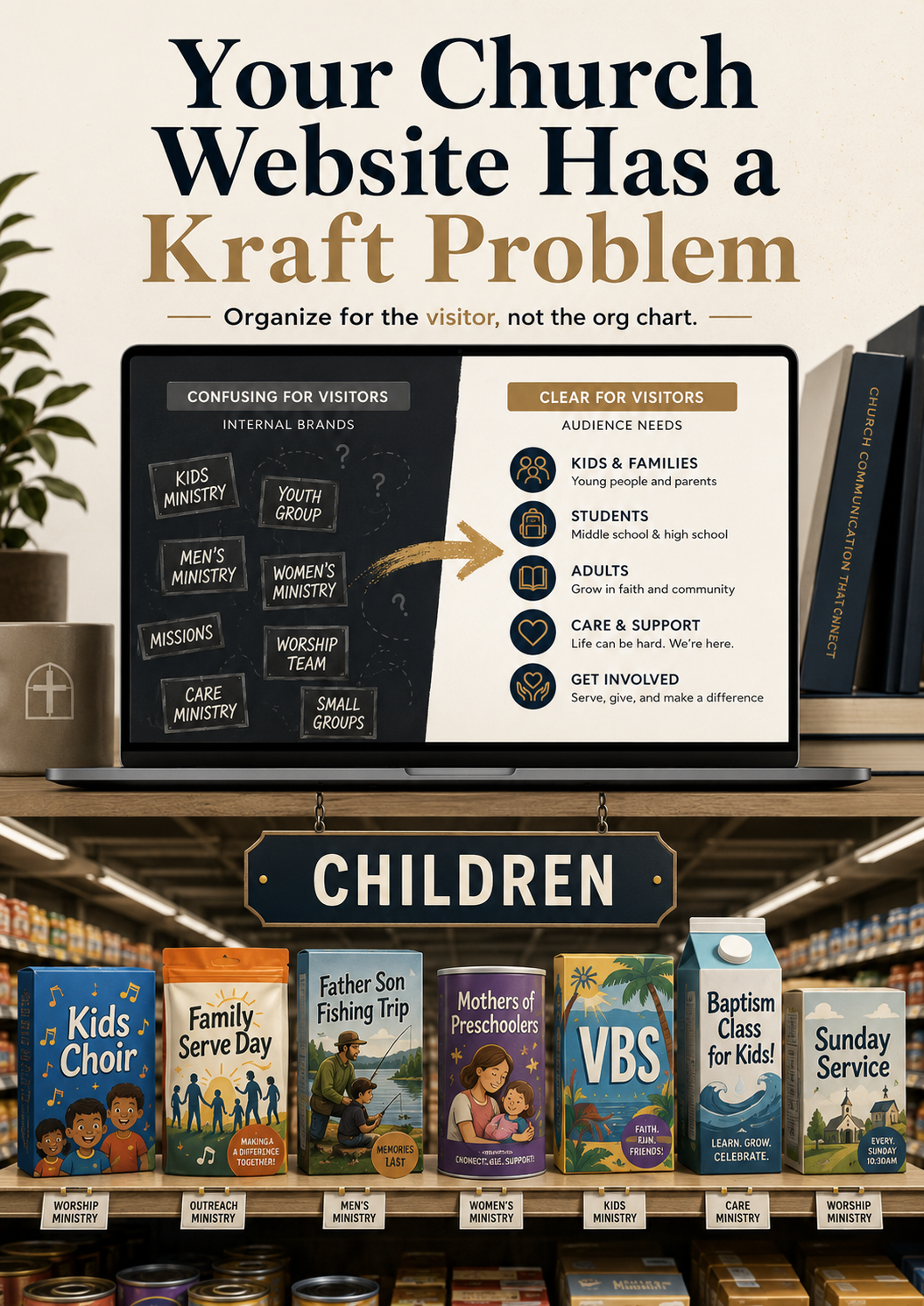
You have a worship ministry page. A men's ministry page. A women's ministry page. A children's ministry page. A young adults page. And then when someone new walks through your doors, whether physically or digitally, you basically say: "Please go walk down the hallway and knock on every single ministry door and ask them what they have for you, if anything."
Think about what that means for a parent.
That parent does not know that the worship team runs a kids choir. They do not know that men's ministry has a father-son fishing trip. They do not know that the discipleship team runs a baptism class for families. Why? Because those things live on ministry pages that a parent would never think to visit.
A grocery store would never do this. A grocery store puts all the condiments together. All the frozen meals together. All the breakfast items together. It does not matter if the ketchup was made by Heinz or by Hunt's, which by the way is owned by Conagra. They sit next to each other on the shelf because the shopper was looking for ketchup.
Your website should work the same way. When a parent visits your kids page, everything for families should be there. The kids choir from worship. The father-son trip from men's ministry. The baptism class from discipleship. All of it. On one page. For that audience.
The Conagra Test
Here is where the exercise got really fun.
I asked the room, "Has anybody heard of Conagra?"
Blank stares. Maybe one uncertain hand.
Then I said, "You know Healthy Choice? Marie Callender's? Chef Boyardee? Orville Redenbacher? Banquet frozen meals? Hunt's ketchup?"
Every head nodded.
Those brands are way more recognizable than the parent company that owns them. Conagra is a $12 billion company and most people could not pick it out of a lineup. But say "Chef Boyardee" and every person in America can picture the can.
Now apply that to your church.
Nobody outside your building knows what "Soul Sisters" is. It could be a women's group. It could be a conference. It could be a podcast. But "women's community" or "women's events"? That, they understand immediately.
Nobody outside your building knows what "Tribe" is. But "college ministry" or "stuff for college students"? That is instantly clear.
We do not get to have a "Kleenex equals the product" level of brand recognition for our internal ministry names. Not yet. Probably not ever. And that is not an insult to your branding. It is just reality. Your internal names serve an important purpose for your people once they are connected. But they cannot be the front door.
The Part Nobody Sees Coming
And this brings us back to where we started.
Kraft owns Heinz. They have been the same company since 2015. Over a decade. And most people reading this right now just found that out for the first time.
Think about that. Kraft has a multi-billion dollar marketing budget. They have billboards, TV commercials, sponsorships, and shelf space in every grocery store in America. And after a decade, most consumers still think Kraft and Heinz are separate companies.
If Kraft cannot get people to recognize what belongs under their umbrella, what chance does your church have of getting a first-time visitor to understand that "Tribe" is your college ministry, not a podcast about survival skills?
Zero. The answer is zero.
And that is okay. You do not need people to know your internal names before they walk through the door. You need them to find the right aisle.
What This Actually Looks Like in Practice
So what do you do with this? Here is how I walk churches through the reorganization.
Stop thinking in ministries. Start thinking in audiences.
Your website is not for your staff. It is for the person who has never been to your church, who is Googling "churches near me" at 11 PM on a Saturday night, trying to decide if they are going to show up tomorrow.
That person is not looking for "Soul Sisters." They are looking for "Is there something here for women like me?"
That person is not looking for "Tribe." They are looking for "Do they have anything for college students?"
Build pages around audiences, not org charts.
Instead of a page for each ministry, build a page for each audience. Kids. Students. College. Young Adults. Men. Women. Seniors. Special Needs.
Then on each audience page, pull in everything from across the church that serves that audience. The college page does not just have Tribe events. It has community groups they can join. Serve opportunities. Rooted classes. Multigenerational groups. Everything.
Because here is the thing I told that church staff: "What I want these pages to feel like is, 'Oh, I did not even think that was possible for me.'" If you only show college students the Tribe page, they miss out on hearing that they can join a multigenerational small group. They miss out on knowing about the serve day that is open to everyone. They miss out on the stuff that will actually keep them connected to the church long after they graduate.
Your ministry leaders become concierges.
This is the mindset shift that makes everything else work. Your ministry leaders are not just running their programs. They are concierges to their audience. That means the college pastor needs to know about the men's events, the community groups, the serve opportunities, and the classes available to his students. Not just his own programming.
Think about a hotel concierge. They do not just tell you about the hotel restaurant. They tell you about every restaurant, every show, every experience in the city. Your ministry leaders need to do the same thing for the people in their audience.
Keep your sub-brands. Just do not lead with them. And always pair them with the term everyone actually searches for.
This is important. I am not saying get rid of Soul Sisters or Tribe or Fight Club or whatever your internal names are. Those names build identity and belonging for the people already connected. That matters.
What I am saying is that on the website, on the front door of your church, the aisle label comes first. Then the brands show up on the shelf.
But here is where churches get into real trouble. They rebrand something like Vacation Bible School as "Summer Bash" or "Adventure Week" and then never mention the words "VBS" or "Vacation Bible School" anywhere on the page. Now when a parent in your community searches "VBS near me" or "Vacation Bible School 2026," your church does not show up. You branded yourself right out of the search results.
Every time you use an internal name, the universally recognized term needs to be right next to it. "Summer Bash" is fine. "Summer Bash: Our Vacation Bible School for Kids" is what actually gets found. "Soul Sisters" is fine. "Soul Sisters: Women's Community and Groups" is what a visitor and a search engine can both understand.
Think about it like the grocery store shelf. The aisle sign says "Condiments" so you can find it. The bottle says "Heinz" so you recognize it. You need both. The aisle sign without the brand feels generic. The brand without the aisle sign means nobody finds the shelf.
Try This With Your Team
If you want to run this exercise with your own staff, here is exactly how to do it.
Print out five to ten sheets, one for each person. Each sheet has a real consumer brand (Kraft, Nestle, General Mills, PepsiCo, Conagra, Unilever) with a list of their actual products underneath. You can find these with a quick Google search.
Write six aisle names on a whiteboard: Dairy and Refrigerated, Bakery and Bread, Pasta Grains and Dry Goods, Snacks and Convenience, Frozen Foods, Condiments Sauces and Cooking Essentials.
Call out each aisle. Ask people to raise their hand if their brand has a product that belongs there.
Watch what happens. Every brand ends up in multiple aisles. No brand fits in just one.
Then ask: "Have you ever seen a grocery store organized by brand?"
Let the silence do the work.
Then say: "Now look at our website. Are we organized by aisle or by brand?"
That is the moment it clicks. I have done this exercise with church teams and watched the room go quiet. Not because they are upset. Because they finally see it. They realize that the website has been organized for the staff, not for the visitor. And once you see it, you cannot unsee it.
The Uncomfortable Truth
Here is what nobody wants to hear.
Your ministry name is not as important as you think it is. Not to a first-time visitor. Not to someone searching online. Not to the parent trying to figure out if your church has something for their family.
Your ministry name matters deeply to the people already inside it. It carries history and identity and belonging. Protect that.
But on your website? On the digital front door of your church? Lead with the aisle. Let people find what they are looking for. Then once they are in the aisle, they will see your brand on the shelf.
That is how grocery stores have done it for a hundred years. It works.
Reed Verdesoto is the founder of eVerde and a Subsplash Brand Ambassador. He helps churches fix their digital presence for long-term success. If your church website is organized by ministry instead of by audience, book an Exploration call and he will show you exactly what to change first.