

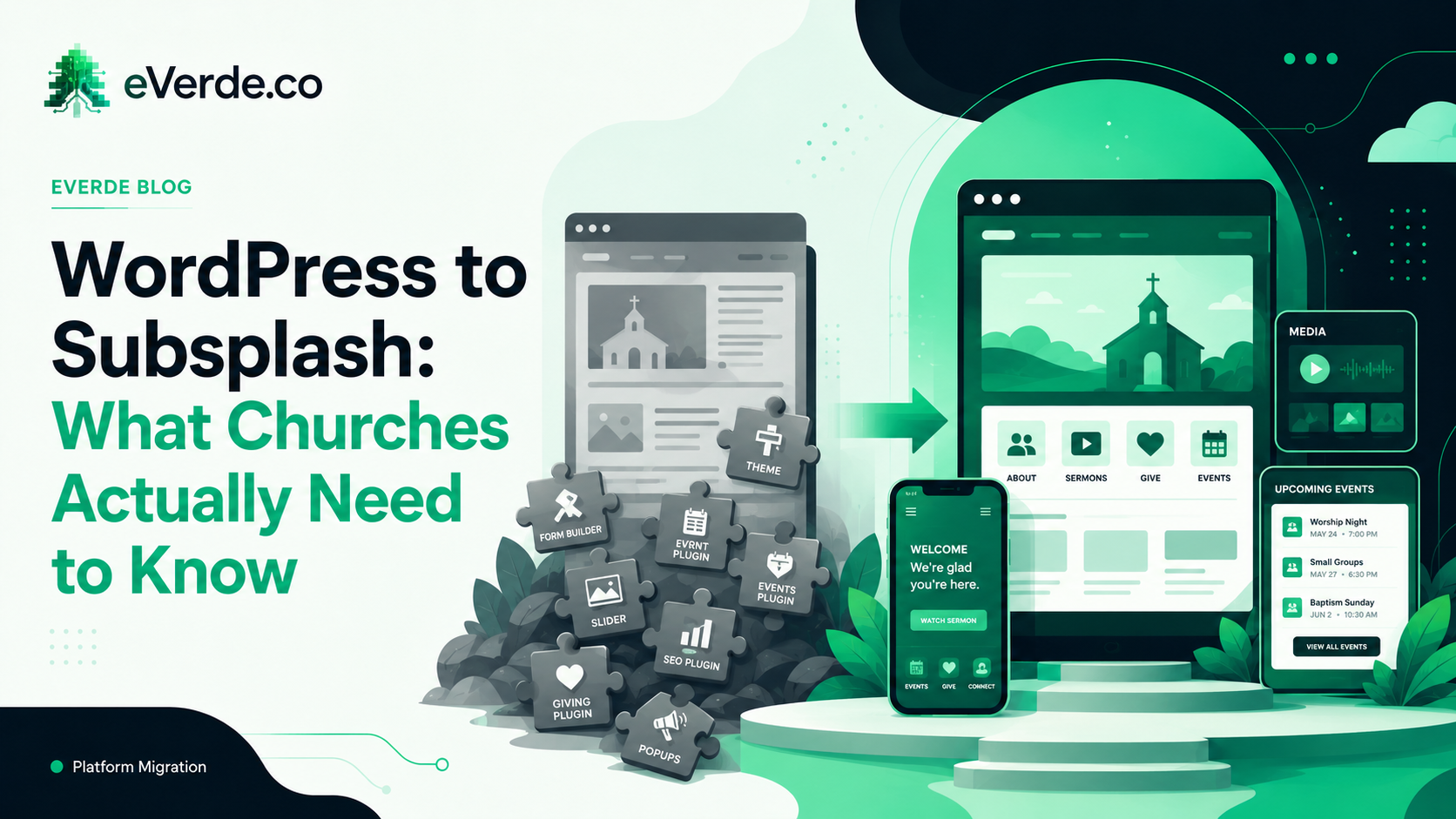
If your church is on WordPress and considering Subsplash, you are probably frustrated with plugin updates, security patches, and a website that takes a developer to maintain. Here is the honest truth about what the migration looks like.
Why Churches Leave WordPress
WordPress is powerful. It can do almost anything. That is also the problem. A church that started with a simple WordPress site five years ago now has 30 plugins, a theme that has not been updated in two years, a page builder that conflicts with the latest PHP version, and a hosting bill that keeps climbing.
The communications person who built the original site left three years ago. Nobody on staff knows how to update plugins without breaking something. The site got hacked once and nobody is confident it will not happen again.
Subsplash eliminates all of that. No plugins. No security patches. No hosting management. No developer needed for basic updates. The platform handles infrastructure so your team can focus on content.
What You Gain
The biggest gain is ecosystem integration. WordPress is a website. Subsplash is a website plus an app plus messaging plus giving plus media plus events in one platform. When you move to Subsplash, you stop duct-taping five different tools together and start working in one system.
Your events show up on the website and in the app automatically. Your sermons publish to both platforms with one upload. Your giving is built in. Your push notifications reach people who downloaded the app. Your communication goes through one dashboard instead of five logins.
For churches, that operational simplification is worth more than any design flexibility WordPress offers.
What You Lose
I will be honest about this. WordPress has more design flexibility than SnapPages. If your church has a heavily custom WordPress theme with unique animations, complex layouts, and bespoke design work, SnapPages will feel more constrained.
You also lose direct database access, custom PHP functionality, and the ability to install any plugin you want. If your church runs a custom membership portal, an e-commerce store, or a complex integration that depends on WordPress hooks, those will need alternative solutions.
For most churches, none of that matters. Most churches use WordPress as a brochure site and none of those advanced features apply. But I tell every church the honest trade-off before we start.
What the Migration Actually Involves
A WordPress to Subsplash migration is not a copy and paste. It is a redesign. Here is why:
Your WordPress site was built with WordPress thinking. Pages were structured around what WordPress made easy. Navigation was shaped by the theme. Content was organized around the page builder's capabilities.
A custom Subsplash build starts from scratch with audience-based architecture. We do not recreate your WordPress site in SnapPages. We design a new site that is built for how Subsplash works, organized around your audiences, and structured so the platform's automation handles most of the updating.
The typical migration process: Discovery session to map your current content and audience needs. Architecture design for the new site structure. Content migration for the text and images that carry over. New page builds in SnapPages with proper hierarchy and SEO structure. App setup if you are adding mobile. Training for your team on the new workflow.
Timeline varies but most churches go from Discovery to launch in 4 to 8 weeks.
When It Makes Sense
Move to Subsplash if: your WordPress site is a maintenance burden, you want an app and website in one platform, your team does not have a developer on staff, and you are willing to trade some design flexibility for operational simplicity.
Stay on WordPress if: you have a developer who maintains the site, you need highly custom functionality, your design requirements exceed what SnapPages can do, or your church runs complex integrations that depend on WordPress infrastructure.
There is no wrong answer. There is only the honest assessment of which trade-off works for your church right now.