
Subsplash Giving vs. Tithe.ly vs. Pushpay: An Honest Comparison
 Reed VerdesotoDigital Systems Architect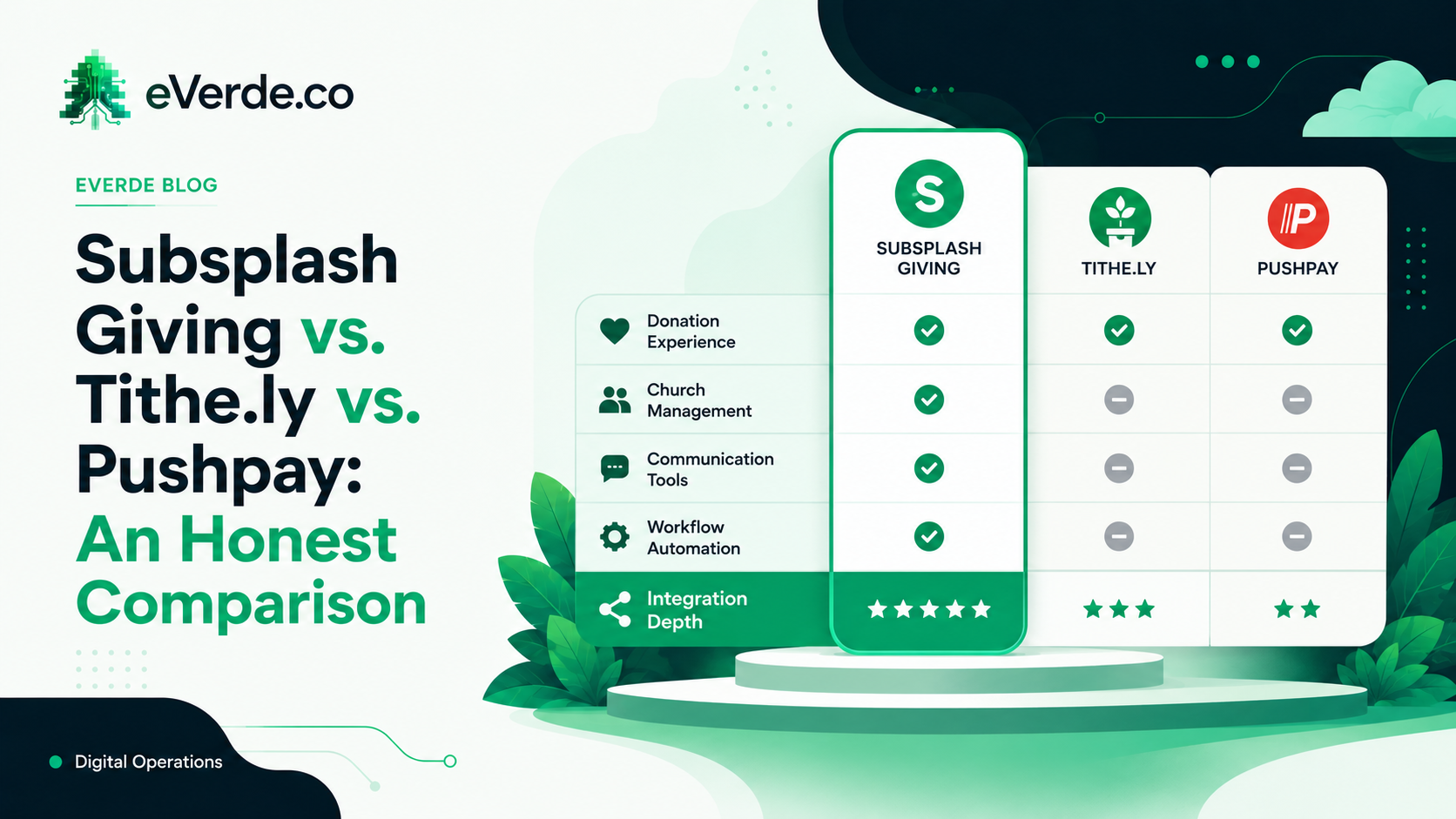
I get asked this question at least twice a month. "Reed, which giving platform should we use?" And the honest answer is that the question itself is usually wrong.
The right question is not "which giving platform has the best features." The right question is "where do our people already interact with our church digitally, and how does giving fit into that ecosystem?"
Features are a tie. Every major giving platform does the core things well. They process donations. They handle recurring giving. They send receipts. They generate reports. If you are comparing feature checklists, you will go in circles because the lists look nearly identical.
What actually differentiates these platforms is how deeply they integrate into the rest of your digital ecosystem. And that is where the conversation gets interesting.
Subsplash Giving
Subsplash Giving lives inside the Subsplash ecosystem. That means giving is native to your app, your website, and your text-to-give setup. It is not a separate login. It is not a redirect to another platform. It is not a widget embedded from a third party. It is the same system that handles your events, your media, your messaging, and your SnapPages website.
For churches already on Subsplash, this is the strongest argument for keeping giving in-house. When a member opens the app to check this week's events and sees the giving tab, there is zero friction. No new account to create. No new interface to learn. No redirect to a different URL. It is all one experience.
The reporting integrates with your broader Subsplash analytics. Donor data lives alongside your audience segments. Push notifications can reference giving campaigns without sending people outside your ecosystem. Everything stays connected.
The trade-off is that Subsplash Giving is built for the Subsplash ecosystem. If you are not on Subsplash for your website and app, the integration advantage disappears. And Subsplash's giving feature set, while solid, is not as deep as platforms that do nothing but giving.
Tithe.ly
Tithe.ly has the lowest barrier to entry. Their free tier is genuinely free for basic giving functionality. For a small church that needs to accept online donations without a significant financial commitment, Tithe.ly is hard to beat on price.
The platform is clean and simple. Setup is fast. The mobile experience is good. And they have expanded into church management tools, so there is a broader ecosystem play happening.
The challenge with Tithe.ly is integration depth. If your church runs on Subsplash for its website and app, Tithe.ly giving lives outside that ecosystem. Donors are redirected. The experience is not seamless. Data lives in a different system. You end up managing two platforms instead of one.
For churches not on Subsplash, or for churches that are cost-sensitive and need a standalone giving solution, Tithe.ly makes a lot of sense. For churches trying to build an integrated ecosystem, it creates a seam.
Pushpay
Pushpay is the enterprise option. It is built for large churches with complex giving needs, capital campaigns, and sophisticated donor management. The platform is powerful, the reporting is deep, and the support infrastructure is built for organizations with dedicated finance teams.
The reality for most churches is that Pushpay is more platform than they need. The pricing reflects the enterprise positioning. The complexity requires more staff time to manage. And unless your church is running at a scale where donor segmentation, wealth analytics, and multi-fund management are daily needs, you are paying for capability you will not use.
I have worked with churches that switched from Pushpay to Subsplash Giving and reduced their giving platform costs significantly without losing the functionality their congregation actually used. The features they lost were features that only the finance team had ever touched.
The Real Question
The question is not which platform has more features. The question is where your ecosystem already lives and how much friction you are willing to accept in the giving experience.
If your church is on Subsplash, keeping giving inside Subsplash eliminates friction, consolidates data, and simplifies your team's workflow. If your church is not on Subsplash, Tithe.ly offers the best value for standalone giving. If your church is at enterprise scale with complex financial needs, Pushpay earns its price.
But there is one more factor that most comparison articles ignore: switching cost. If your congregation is already trained on a giving platform, switching creates friction even if the new platform is objectively better. Donors have saved payment methods, recurring gifts, and muscle memory. Changing platforms means re-onboarding every donor. That cost is real and it is not measured in subscription fees.
Before you switch anything, ask whether the problem is the platform or the architecture around the platform. Most of the time, it is the architecture. And architecture can be fixed without changing a single tool.
Originally published on reedverde.com