
Product Primer
Platform & Commerce Systems in this context means building infrastructure before products. It is the practice of structuring creative brands so that merchandise, events, community, and IP can scale without fragmenting.
The Story
Most creative brands stall because they build products before they build infrastructure.
Cryptid Empire was not just a t-shirt idea. It was a universe. A mythology. A personality. A tone that intentionally blurs the line between belief and parody. But without structure, even the most creative ideas fragment quickly. Social posts go one direction. Merch goes another. Events live in spreadsheets. Opportunities get missed.
The goal was not to "make a website." The goal was to build an ecosystem that could support creative momentum without collapsing under its own weight.
ReedVerde took full responsibility for the platform, and for the architecture underneath it.
Phase 1: From Artist to Architecture
David J. Hardie is a creator. That's the engine. But creators often end up buried under operational noise: fulfillment questions, store structure, variant pricing, inventory tracking, affiliate ideas, wholesale requests, event coordination, and content scheduling.
So the first shift was not design. It was separation.
We clarified the lanes: HardieWear as the production and apparel engine. Cryptid Empire as the mythological brand universe. Speaking and live appearances as a separate revenue path.
Once those lanes were defined, the digital architecture could support them instead of blending them into confusion.
Phase 2: Building the Store Like a System
The Shopify infrastructure behind Cryptid Empire is not random product uploads. It is structured intentionally.
Variant pricing rules. Inventory logic. Event-specific drops. Wholesale pathway planning. Future affiliate models. Analytics layering.
Even pricing decisions like XXL and XXXL adjustments were systematized rather than improvised. Shipping logic was cleaned up. Product templates were standardized. Storefront presentation aligned with tone.
Because creative chaos feels fun until you have to scale it.
Phase 3: Events as Momentum Engines
Cryptid Empire lives heavily in physical events, conventions, expos, appearances. Instead of treating events as one-off dates, we structured them as momentum engines.
Event listings were consolidated. Appearances were centralized. Calendar logic was aligned. Merch planning was tied to event strategy.
Instead of reacting to events, the brand began anticipating them. Structure creates breathing room for creativity.
Phase 4: Brand Tone as Infrastructure
Cryptid Empire intentionally leans playful, meta, and self-aware. It does not take itself too seriously, but it also isn't unserious. That tone needed protection.
So everything digital, site copy, product descriptions, landing pages, reinforces that tension. It celebrates mythology without pretending to be research. It plays with cryptids without becoming parody. It leaves room for faith-forward elements without turning into a sermon.
Tone consistency is architecture. If tone drifts, trust erodes.
Phase 5: Preparing for Community
Beyond merchandise, Cryptid Empire is building toward something larger: community. Discord structures. Twitch streams. Live recordings. Collaborations. Book funnels that drive apparel sales.
Those are not random ideas. They require sequencing. Infrastructure. Platform coordination.
The strategy has been to build foundations first so that when the community layer activates, it rests on structure instead of scrambling.
The Work
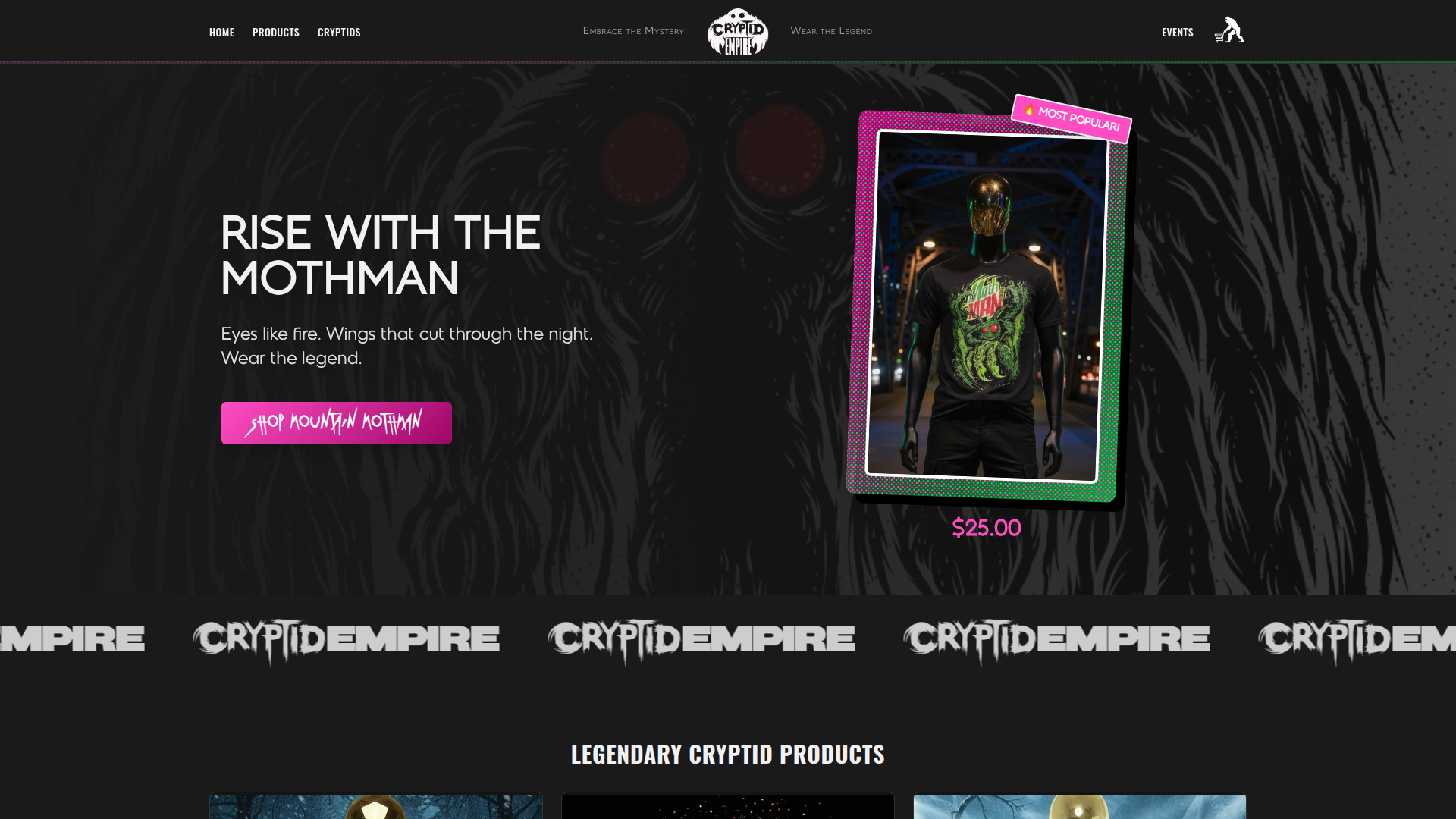
Outcome
Cryptid Empire is no longer just a creative outlet. It is a structured brand universe capable of supporting merchandise, live events, community building, and long-term intellectual property.
The creative engine is still intact. But now it sits on architecture.
That's the difference between having a brand and building an ecosystem.
Check it out yourself
Ready to Design Your Evergreen Presence?
Let's talk about what's possible when systems are built to last.