

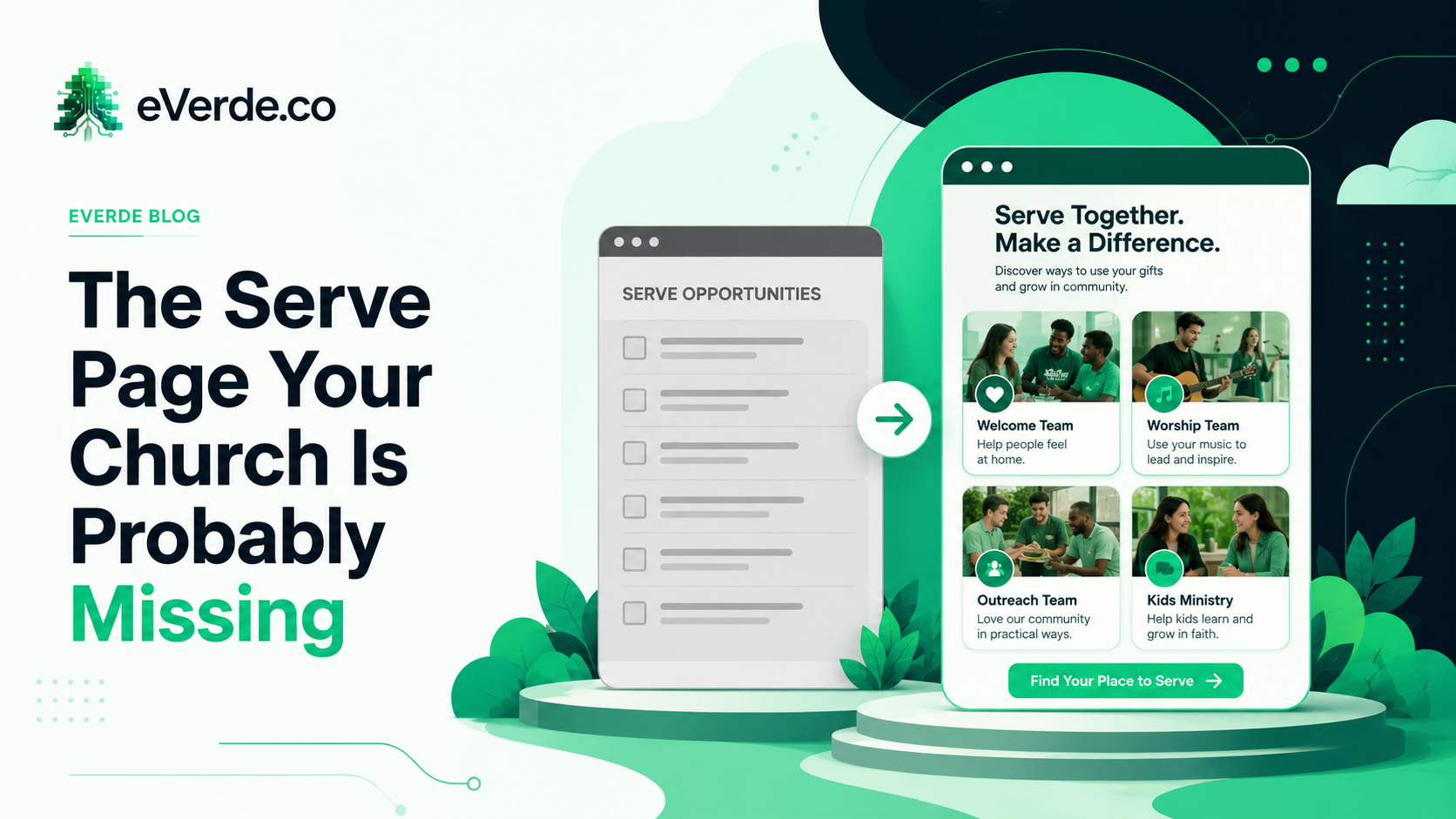
Pull up your church's serve page right now. What does it look like? If the answer is a list of ministry areas with descriptions and a sign-up link for each one, you have built a job board. And job boards do not inspire people to volunteer.
The serve page is one of the most important pages on your church website, and it is almost always one of the worst. Not because churches do not care about volunteers. Because the page is structured around what the church needs instead of what the volunteer is looking for.
People do not sign up for tasks. They sign up for belonging. They sign up because they saw a photo of real people doing something meaningful and thought, "I want to be part of that." They sign up because the page made them feel like they were already welcome before they filled out a form.
The Problem with Role Lists
A page that says "Greeting Team: Welcome guests as they arrive. Sign up here" is technically accurate. It is also completely uninspiring. It reads like a job description. And the last thing a person sitting in your congregation on a Sunday morning wants to do is apply for a job.
Role lists answer the question "what do we need." They do not answer the question the visitor is actually asking, which is "what would it feel like to be part of this?"
That is a fundamentally different question. And it requires a fundamentally different page.
What a Good Serve Page Does
A good serve page leads with photos. Real photos. Not stock images of diverse hands in a circle. Actual candid shots of your volunteers doing what they do. The coffee team laughing while setting up. The kids ministry leader high-fiving a first grader. The parking team waving people in during the rain.
Those photos do something a role description never can. They show the experience. They create desire. And desire is the first variable in the engagement formula. Without it, nothing else matters.
After the photos, each ministry area gets its own visual lane. Not a bullet point in a list. A section. With a photo, a short description written from the volunteer's perspective (not the church's perspective), and a single clear next step.
"Join the team" is a better button than "Sign up." "I'm interested" is even better. The language should feel like an invitation, not an application.
Registration Should Be One Tap
If someone clicks "I'm interested" and lands on a form that asks for their name, email, phone number, address, spiritual gifts assessment, availability for the next six months, and a background check authorization, you have just lost them.
The first form should collect a name and an email. That is it. Everything else happens after the connection is made. The goal of the serve page is not to process a volunteer. It is to start a conversation.
In Subsplash, this means using a simple form tied to a tag. When someone submits the form, they get tagged with the ministry area they expressed interest in. A staff member or ministry leader gets notified. The follow-up happens personally, not through a system.
Treat It Like an Audience Page
The serve page is an audience page. The audience is people who are ready to move from attending to participating. That is a significant emotional step. The page should honor that step by speaking to the person, not the org chart.
"You have something to offer" is better than "We need volunteers." "Find where you fit" is better than "Browse our ministry areas." The framing matters because it determines whether someone feels recruited or invited.
Structure Every Serve Opportunity as an Event
Here is a practical Subsplash move that most churches miss. Every serve opportunity should exist as a structured event in Subsplash. Not just the one-time serve days. The ongoing teams.
When a serve opportunity is a structured event, it gets reminders. It gets push notifications. It gets calendar integration. It gets category tags that let you segment and communicate with volunteers differently than you communicate with the general congregation.
A paragraph on a page is just text. An event is infrastructure. And infrastructure is what turns a sign-up into a sustained commitment.
The Serve Page Nobody Builds
The serve page most churches need is not a list. It is a landing page that sells belonging, shows the real experience through real photos, gives each ministry area its own visual space, makes the first step effortless, and connects every opportunity to structured follow-up inside the platform.
Build that page and watch what happens to your volunteer engagement. Not because you changed the ministry. Because you changed how people experience the invitation.
Originally published on reedverde.com