

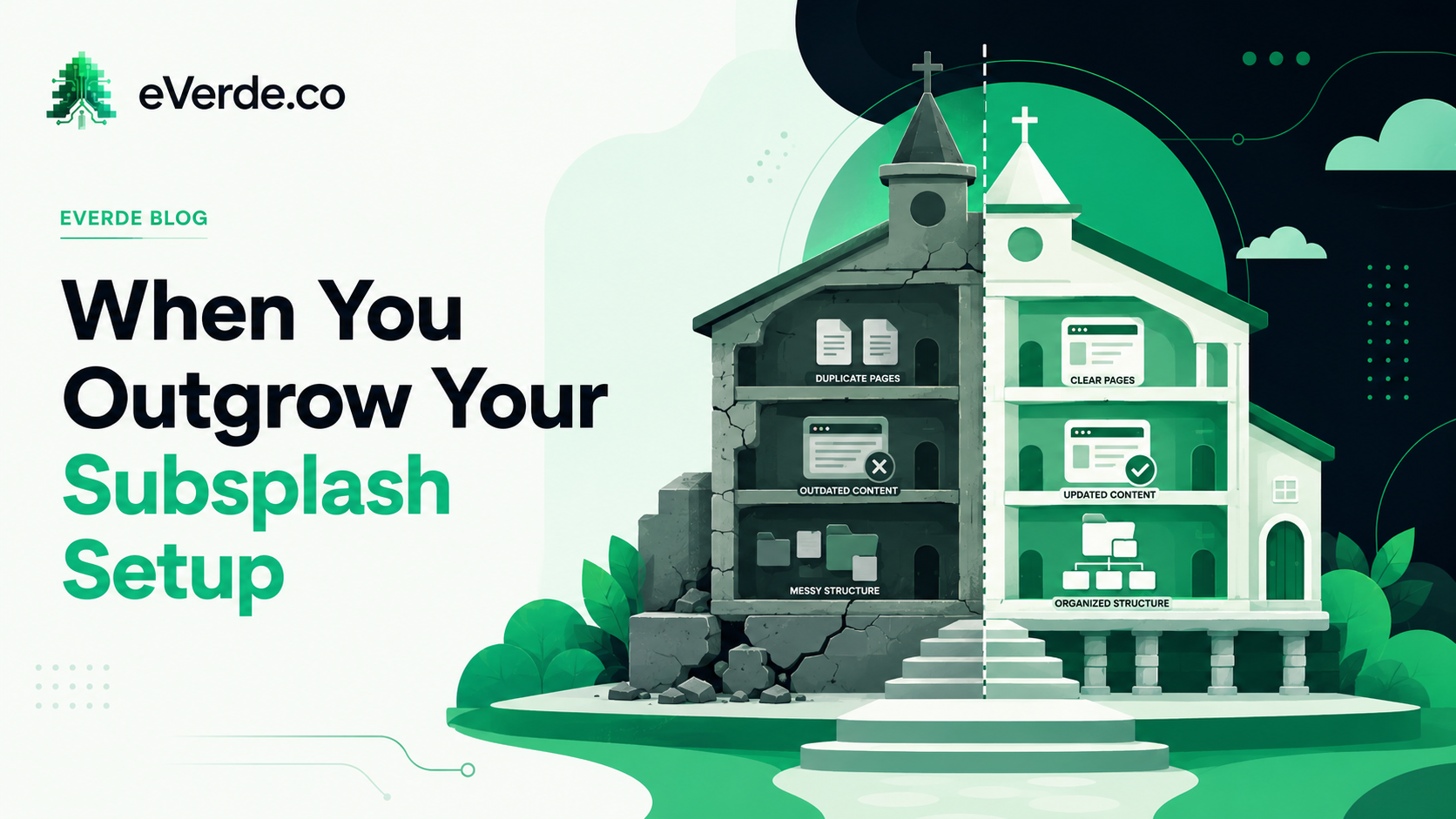
At some point, every growing church hits a wall with their digital setup. The app feels cluttered. The website has pages nobody maintains. Events are duplicated across the calendar and the app. Push notifications are inconsistent. The staff is confused about what lives where. And someone in a leadership meeting says, "Maybe we need a different platform."
They do not need a different platform. They need different architecture.
The Signs You Have Outgrown Your Setup
There are predictable signals that a church has outgrown its Subsplash architecture. Duplicate events appearing in different places. Staff members creating content in different areas of the dashboard without coordination. The app navigation has more tabs than anyone uses. The website has pages that have not been updated in months. Push notifications go out from different staff members with no consistent schedule or tone. The sermon archive is disorganized. The event calendar is a wall of undifferentiated listings.
None of these are Subsplash problems. They are architecture problems. They are symptoms of a system that was set up once, probably quickly, probably without a documented plan, and has been accumulating decisions ever since.
Every undocumented decision adds weight to the system. After two or three years, the accumulated weight makes the whole setup feel broken. But the platform underneath is fine. The structure on top of it is what failed.
The Rebuild Trap
The natural instinct when a system feels broken is to start over. Redesign the website. Rebuild the app structure. Migrate to a new platform. Start fresh.
This is the most expensive mistake a church can make. Because starting over does not fix architecture. It resets the clock. You get a clean system that looks great at launch and begins accumulating the same undocumented decisions immediately. In two more years, you are back in the same meeting, asking the same question.
I have seen churches go through three platform migrations in six years, spending $30,000 or more, and ending up with the same problems each time. The platform was never the issue. The absence of architecture was the issue. And no platform migration fixes that.
Restructuring vs. Rebuilding
Restructuring is what most churches actually need. It means taking the existing platform and redesigning the architecture inside it. New taxonomy. New governance documentation. New navigation hierarchy. New content authority framework. New workflows.
Restructuring keeps your existing content, your existing integrations, your existing audience data, and your existing app install base. It does not require your congregation to download a new app or learn a new website. It requires your staff to learn new workflows and follow new governance.
That is cheaper, faster, and more effective than rebuilding from scratch. And it produces results that last because the architecture is documented this time.
What Restructuring Looks Like
When ReedVerde restructures a Subsplash setup, we start with the same Discovery process used for new builds. We map the current system. We identify where architecture is missing, where governance has drifted, and where content has accumulated without strategy.
Then we design the new architecture. What should the navigation look like now? What pages should exist and what should be retired? How should events be categorized? What audience tags need to be created or cleaned up? Who creates content, who approves it, and how does it flow from creation to publication?
The restructuring itself happens in sprints. Sprint one might be taxonomy and governance. Sprint two might be navigation and page hierarchy. Sprint three might be app structure and media organization. Each sprint is tied to documented architecture, not improvisation.
When to Restructure
If your Subsplash setup is more than two years old and you have never done a structural audit, it is time. If your staff cannot explain how content moves from creation to publication without hesitating, it is time. If your app navigation has more than five tabs and most of them are ignored, it is time. If you are about to spend money on a redesign, stop and restructure first.
The money you spend on restructuring saves you the money you would spend on a rebuild. And unlike a rebuild, restructuring produces documented architecture that prevents the next cycle from happening.
Architecture Over Aesthetics. Always.
This is the principle underneath everything ReedVerde builds. It does not matter how beautiful your website is if the architecture behind it cannot sustain growth. A clean design on a messy structure is a countdown timer to the next redesign.
Architecture is not about what it looks like. It is about how it lasts. When architecture leads, the system scales. When aesthetics lead, the system decays.
If your Subsplash setup feels like it is falling apart, it probably is. But the fix is not a new platform. The fix is the architecture that should have been there from the beginning.
Build it now. Document it. Govern it. And stop rebuilding.
Originally published on reedverde.com